Rung 03 of 6 on the ladder
Motion Preservation and Disc Replacement
When a level can be decompressed without being locked down, that is usually worth doing.
What it is
The short version.
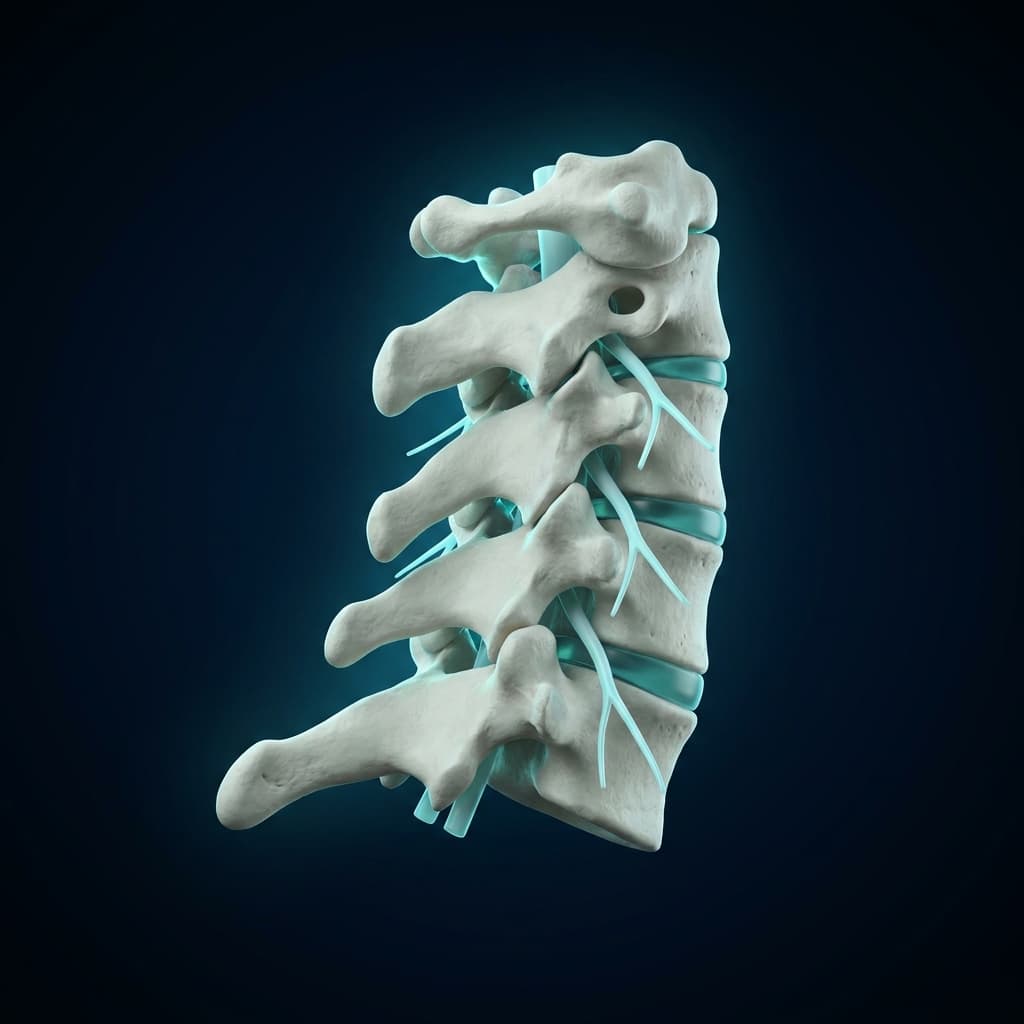
Disc replacement, also called arthroplasty, removes a degenerated disc and the compression it is causing, then places an implant designed to preserve movement at that level instead of fusing it. Motion preservation is the broader principle behind it: decompress the nerve or the spinal cord completely while leaving as much of the segment's normal mechanics intact as the anatomy allows.
Fusion treats a compressive or unstable level by removing the disc and permanently joining the two vertebrae. It is reliable, it is well studied, and for many problems it remains the correct operation. The trade is mechanical: the motion that level used to provide does not disappear, it is redistributed to the segments above and below, which may accelerate their wear over the years that follow.
An arthroplasty removes the same disc and performs the same decompression, then preserves movement at that segment rather than eliminating it. The aim is to relieve the nerve or the cord without transferring the entire mechanical demand onto the neighboring levels.
Is disc replacement better than fusion?
For the patients it suits it can be, but it is not a universally superior operation and I would be misleading you to present it as one. An artificial disc depends on the rest of the segment being healthy enough to move safely. Significant facet arthropathy is the most common disqualifier: the painful joints at the back of the segment stay in play, so preserving motion may preserve the pain. Meaningful instability or spondylolisthesis, severe osteoporosis, and deformity that needs correcting are all reasons an implant designed to move is the wrong choice, because it cannot hold what needs holding. In those situations fusion is not a compromise, it is the operation that addresses the actual problem. Fewer patients qualify for disc replacement than the marketing around it tends to suggest, and being told you are not a candidate is not a consolation prize.
What it offers
Where this approach earns its place.
Motion retained at the treated level
The segment is decompressed without being locked, which for appropriately selected patients may preserve a more natural range of neck or back movement than a fusion at the same level.
Potentially less demand on adjacent levels
Because the treated segment continues to move, less load is transferred to the levels above and below. The intent is to reduce the risk of adjacent segment degeneration over time, though no operation eliminates it.
The decompression is not compromised
The nerve root or spinal cord is decompressed in the same way it would be during a fusion. Preserving motion changes what happens after the disc is removed, not how thoroughly the compression is relieved.
No fusion has to heal
There is no bone graft waiting to consolidate at that level, so there is no pseudarthrosis to worry about there, and the postoperative restrictions are often different from those after a fusion.
Procedures
What this looks like in practice.
Motion preservation is decided level by level, and the same patient can need an arthroplasty at one level and a fusion at another. These are the motion-preserving procedures I perform.
Cervical Disc Replacement
A motion-preserving alternative to fusion that replaces a damaged cervical disc with a prosthetic implant to relieve arm pain, numbness, or spinal cord pressure.
Lumbar Disc Replacement
A motion-preserving lumbar procedure that replaces a degenerated disc with an artificial implant rather than permanently fusing the adjacent vertebrae.
When it is the right choice.
Disc replacement is considered when a specific disc is compressing neural structures at a level that is otherwise mechanically sound, not simply because preserving motion sounds preferable in the abstract.
- Single-level or two-level cervical disc disease causing radiculopathy or myelopathy
- Compression arising principally from disc material rather than extensive bony overgrowth
- Preserved disc height and preserved facet joints at the level in question
- Absence of instability, spondylolisthesis or deformity requiring correction
- Adequate bone quality to support an implant
- Symptoms that have not resolved after a reasonable course of non-surgical care
Am I a candidate?
The question is usually put plainly: can I avoid a fusion? These are the factors that decide it.
- Your bone density is adequate to support an implant, which sometimes requires a formal bone density study first
- The facet joints at that level are not themselves a significant source of your pain
- Flexion and extension x-rays show no meaningful slip or abnormal motion at the segment
- Your symptoms are attributable to one or two levels rather than to diffuse multilevel degeneration
- You do not have an active infection, inflammatory arthropathy, or a known metal sensitivity that would affect implant selection
How I approach it
Disc replacement requires more than placing an implant. It demands proving the level deserves one.
Most of the work in an arthroplasty happens before the operation, in deciding whether the segment can safely be left mobile. That means standing and dynamic x-rays rather than the MRI alone, a look at the facet joints on CT when the question is close, and an honest assessment of bone quality. In the operating room, the parts that matter most are unglamorous: true midline, careful preparation of the endplates, and correct sizing, because an implant that is not seated squarely will not move the way it was designed to. I plan every disc replacement with fusion as the declared alternative, and if what I find once the disc is removed tells me the segment should not be left mobile, I will fuse it. That is a conversation I would rather have with you beforehand than explain afterwards.
Motion Preservation: questions patients ask
How long does an artificial disc last?
Modern cervical disc implants are designed for long-term function and the published follow-up now extends many years, with most patients in those studies not requiring further surgery at the treated level. That is not a guarantee for any individual. Implants can loosen, the level can stiffen and fuse on its own over time, and revision is possible if it becomes necessary, usually by converting the level to a fusion.
Can I have a disc replacement if I already had a fusion at another level?
Sometimes. Combining an arthroplasty at one level with a fusion at another, often called a hybrid construct, is a recognized approach and can be appropriate when one level needs stabilizing and the other does not. Whether it suits you depends on the alignment of your spine, the condition of the facet joints at the level being considered, and how much motion remains overall.
Why is lumbar disc replacement performed less often than cervical?
Because the qualifying criteria are narrower in the low back. Lumbar levels carry far more load, and facet arthropathy, spondylolisthesis and multilevel degeneration are common there, all of which argue against preserving motion at the segment. The result is that a smaller proportion of lumbar patients are suitable candidates. It remains a reasonable option for a carefully selected group, typically younger patients with isolated single-level disc disease and healthy facet joints.
What are the activity restrictions after disc replacement?
They tend to differ from those after fusion, since there is no bone graft that has to consolidate. Many patients are encouraged to move early and to resume walking almost immediately, with limits on heavy lifting and on extremes of bending or twisting for a period of weeks. The specifics depend on which level was treated and on how the implant sat, so I set them individually rather than by protocol.
Where can I be evaluated for disc replacement in Macomb County?
I see patients in Shelby Township and evaluate candidates from across Macomb County and Metro Detroit, including Sterling Heights, Utica, Macomb Township, Clinton Township and Rochester Hills. For a disc replacement assessment it helps to bring an MRI and, if you have them, standing flexion and extension x-rays, since candidacy usually turns on stability and facet condition rather than on the MRI alone.
Related conditions
Problems this is used to treat.
Been told you need a cervical fusion and wondering whether there is another option?
Bring your MRI and any flexion and extension x-rays. Whether motion can be preserved is usually visible on those two studies.
Shelby Township, Macomb County. Call (586) 803-1220.